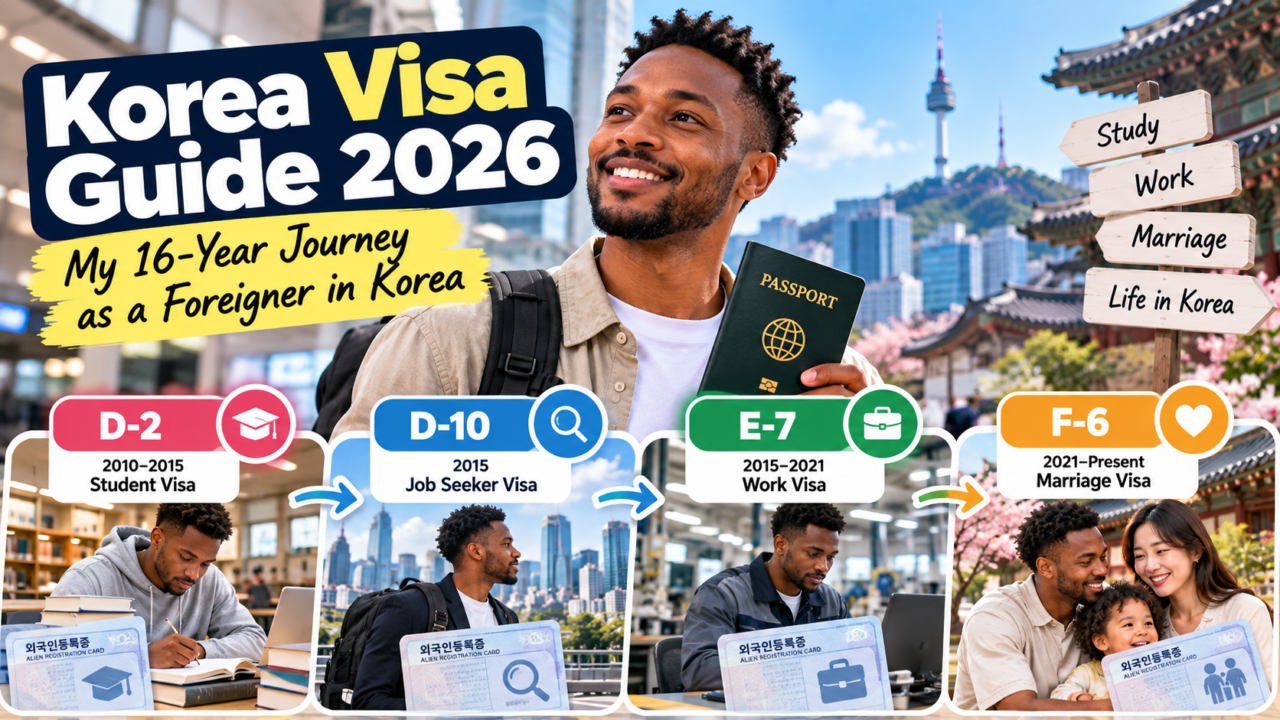
When I arrived in Korea in 2010, I wasn’t thinking about F visas, permanent residency or how Korean immigration would affect my career.
I was a student.
I had received a scholarship from an organization to study in Korea, packed my bags and arrived on a D-2 student visa.
Sixteen years later, I’m still here.
During that time, my visa journey has looked something like this:
D-2 Student Visa → D-10 Job Seeker → E-7 Work Visa → F-6 Marriage Visa
And somewhere in the middle, I accidentally changed jobs without properly dealing with immigration first. 😅
That mistake nearly earned me a fine and eventually required me to leave Korea and apply for my E-7 again.
So if you’re planning to study, work and potentially build a life in Korea, here’s what I’ve learned.
Important: My personal experiences stretch from 2010 to 2026. Korean immigration rules have changed considerably during that time. Where I discuss current requirements, I’ve checked them against current Korean government sources. Always confirm your individual situation with Hi Korea or Immigration Contact Center 1345 before making a visa decision.
2010: Arriving in Korea on a D-2 Student Visa
My Korean journey started with a scholarship.
The organization providing the scholarship handled most of my original visa process, so I can’t pretend that I personally fought through mountains of D-2 paperwork.
I didn’t.
I was actually quite lucky.
After arriving in Korea, however, I still needed to deal with immigration and obtain what we all called the Alien Registration Card (ARC).
These days you’ll increasingly see it referred to in English as the Residence Card.
My university helped considerably with that process and continued assisting with my visa extensions while I remained a student.
For me, the actual immigration process wasn’t particularly difficult.
The bigger problem was something many foreigners in Korea will recognize: language.
Remember, this was 2010.
There wasn’t nearly as much English-language information online as there is today. Finding out what document you needed, where you needed to go and what exactly immigration wanted could sometimes be more difficult than the application itself.
Thankfully, things are considerably better today.
Korea Immigration Service provides online information, Hi Korea handles a growing number of immigration services, and the Immigration Contact Center 1345 provides immigration and living-information assistance in multiple languages.
D-2 today
The D-2 remains Korea’s main study status for foreigners enrolled in regular programs at colleges, universities and qualifying academic or research institutions.
One thing students should be careful about is employment.
Having a D-2 does not simply mean you can take whatever part-time job you want. Part-time employment can require permission and is subject to immigration conditions.
Never assume that because another international student is doing something, you’re automatically allowed to do it too.
2015: Graduation — and My Move to D-10
After finishing university in 2015, I switched from D-2 to a D-10 job-seeking visa.
This was actually the first visa application I handled mostly by myself.
And surprisingly? It wasn’t stressful.
I don’t remember every document I submitted—and rather than pretending I do, I’m not going to give you a 2015 document checklist and call it a 2026 guide.
What I remember clearly is that the process itself was fairly straightforward.
The D-10 gave me time to look for employment in Korea after graduation.
D-10 is even more interesting for graduates today
The system has changed since I used it.
Korea has expanded the job-seeking period available to qualifying international graduates of Korean universities. Under the newer system, the maximum job-seeking period can reach three years, with extensions made in one-year increments rather than the previous six-month increments.
Internship rules for qualifying graduates have also been expanded.
But don’t read that as “everyone gets three years automatically.” Your eligibility and permitted activities still depend on your circumstances and the applicable D-10 category.
2015: I Found My First Job and Switched to E-7
Fortunately, I found my first professional job in Korea during 2015.
That meant another visa change: D-10 → E-7.
My employer handled most of the E-7 application, and again, the process was pretty straightforward.
At the time I was simply happy about starting my career in Korea.
What I hadn’t fully appreciated was how different living on an employer-connected work visa would feel.
The E-7 Was Great for My Career… But I Felt Tied to My Company
This was probably my biggest frustration with the E-7.
My ability to work in Korea was connected to my employment and the conditions of my visa.
I couldn’t simply think: “I don’t like this company anymore. I’ll start working somewhere else on Monday.”
And outside work wasn’t something I could casually take on either.
After a while, I felt less like I had complete control over my career and more like my visa had control over it.
My less diplomatic description at the time? I felt like a slave to the visa and the company.
That’s obviously describing how the situation felt to me, not the legal definition of an E-7.
And this distinction is important because today’s rules are more nuanced than saying: “E-7 holders cannot change companies.”
Depending on the particular E-7 situation, changing or adding a workplace may involve immigration permission or a qualifying workplace-change/addition reporting procedure.
Never start working for a new company assuming your existing E-7 automatically follows you. Check with immigration first.
The E-7 Mistake That Nearly Cost Me a Fine
At one point I decided to change employers.
I got another job and changed companies.
Simple, right?
Not quite.
I later discovered that I hadn’t properly completed the immigration requirements for changing my workplace.
I could have been fined.
Fortunately, the immigration officer dealing with my case was understanding and the fine was not ultimately imposed in my situation.
But I still had a problem to solve.
In my particular case, I had to leave Korea and go through the visa application process again so that I could return under the E-7 connected with my new employment.
That experience taught me one of the biggest immigration lessons I’ve learned in Korea:
Getting a new job and being legally allowed to start that job are two different things.
Don’t resign, sign another contract and start working somewhere else based purely on what your coworker, recruiter, HR manager or friend says.
Check immigration.
The Visa Decision I Would Change If I Could Go Back
I stayed on E-7 until 2021.
Looking back, there’s one thing I would do differently.
I would have seriously pursued an F-2 much earlier.
I knew about F-2 while I was on E-7.
Why didn’t I pursue it?
Honestly? Paperwork. 😂
I didn’t want the hassle.
At the time it was easier to keep renewing the visa I already had.
Looking back, I think that was shortsighted.
Don’t get too comfortable with the E-7. Find out whether you can qualify for an appropriate F-2 route and start preparing as early as possible.
That doesn’t mean every E-7 holder qualifies for F-2. There are multiple F-2 categories, with different eligibility conditions, and some categories provide broader employment freedom than others.
The bigger lesson is this:
Don’t only plan your next visa renewal. Plan your next visa.
2021: Marriage and My Move to F-6
In 2021, after getting married, I changed from E-7 to an F-6 marriage visa.
My wife and I handled the application ourselves.
Compared with some of the horror stories you sometimes hear online, ours was actually quite uneventful.
We checked the requirements. We prepared the documents. We submitted everything. And the application went smoothly.
There’s a lesson hiding in there too.
Korean immigration can feel intimidating, but in my experience many problems came from not having the correct document or not understanding a requirement, rather than the application itself being impossibly complicated.
F-6 Completely Changed How I Felt About Working in Korea
The difference between my E-7 experience and F-6 was huge.
For the first time in years, I didn’t feel that my ability to work in Korea was tied to one particular employer.
I could change jobs much more freely. I could pursue other work. I could consider part-time opportunities.
Basically: I no longer felt like a slave to the company. 😂
And current immigration law supports the broader point behind my experience: F-6 holders are among the categories exempt from the ordinary status-based restrictions on employment activities.
Of course, normal Korean laws still apply. Having an F-6 doesn’t magically give you a medical licence, let you ignore business regulations or make otherwise illegal work legal.
I’m still living in Korea on F-6 today.
What 16 Years of Korean Immigration Taught Me
Bring more documents than you think you’ll need
This is probably my number-one practical tip.
I’ve had several situations where I arrived at immigration thinking I had everything… only to discover that I was missing one document.
Then you get to enjoy the exciting prize of: another trip to immigration. 🎉
If you have supporting documents that might reasonably be relevant to your application, I would rather have them with me and not need them than need them and have them sitting at home.
That doesn’t mean random paperwork can replace an official requirement. Always check the official document list first.
Don’t Be Afraid of the Immigration Officers
I’ve dealt with Korean immigration many times over the years.
Personally, I haven’t had experiences with officers being intentionally rude or difficult.
My experience has generally been the opposite. They’ve been willing to explain things when I didn’t understand.
So when you’re at the counter: be polite.
If you don’t understand something, ask again. If your Korean isn’t good enough, say so. Don’t pretend you understood an important immigration instruction because you’re embarrassed to ask twice.
Ask About the Maximum Period of Stay Available
Another thing I’ve learned is simply to ask: “Is it possible to receive the maximum period available for my extension?”
That doesn’t mean the officer is required to give it to you. The period granted depends on your visa category, eligibility and circumstances.
Korea Immigration Is Much Easier to Navigate Than It Was in 2010
One thing I genuinely envy about foreigners arriving today is access to information.
When I arrived in 2010, finding reliable English information wasn’t always easy.
Today you have official online resources, electronic immigration services and the 1345 Immigration Contact Center.
Some immigration services, including extensions and certain workplace-change procedures, can also be processed electronically through Hi Korea.
Korea even introduced a mobile Residence Card, which carries the same legal validity as the physical Residence Card.
Immigration bureaucracy hasn’t disappeared.
Unfortunately, nobody has invented the “Just trust me bro, I’ve lived here for years” visa yet.
But getting reliable information is much easier than when I arrived.
My Biggest Advice If You Want to Stay in Korea Long-Term
If you’re coming to Korea as a student and eventually want to build a career and life here, don’t think of immigration as something you deal with once a year when your visa expires.
Think several years ahead.
Mine happened to be:
2010 — D-2 Student → 2015 — D-10 Job Seeker → 2015 — E-7 Professional Worker → 2021 — F-6 Marriage Migrant → Today — Still F-6
Yours might eventually involve a different F-2 category, F-5 permanent residency or another route entirely.
The important thing is understanding what options you may qualify for.
And if there’s one lesson I’d really like you to take from my E-7 experience, it’s this:
Before changing employers, taking additional work or making any major employment decision that could affect your visa, check the immigration rules first.
Where to Check Korean Visa Information
Immigration rules change, so don’t rely solely on an old blog post—including this one.
Hi Korea (하이코리아 / Hai Korea) — Korea’s official immigration e-government portal.
Korea Immigration Service (출입국·외국인정책본부 / Churipguk Oegugin Jeongchaek Bonbu) — Ministry of Justice immigration information, policy announcements and official guidance.
Immigration Contact Center — 1345 — useful when you’re unsure how a rule applies to your specific situation.
Your friend’s visa situation is not automatically your visa situation.
This article is based partly on my personal experience living in Korea since 2010. It is general information, not immigration or legal advice. Visa requirements and procedures can change. Verify your individual requirements through Korea Immigration Service, Hi Korea or Immigration Contact Center 1345 before applying or changing employment.