Moving to South Korea is exciting, but the weeks before and after the move can feel like one long list of things you are supposed to know already.
I have lived in Korea for many years, and one thing I have learned is that settling in becomes much easier once you handle things in the right order. You do not need to understand every Korean system before you arrive. You just need to know what matters first, what can wait, and where to double-check information when rules change.
This checklist is designed for exactly that. Bookmark it before you move, then come back to it during your first few weeks in Korea.
1. Confirm Your Visa Before You Build the Rest of Your Plan
Your visa or status of stay affects almost everything that comes afterward: how long you can remain in Korea, whether you can work, what documents you may need after arrival, and sometimes which services are available to you.
Do not rely on an old blog post, a social-media comment, or what happened to a friend several years ago. Immigration requirements can change and individual circumstances matter. Before booking around a visa assumption, confirm your situation through the Korean immigration authorities or the Korean embassy or consulate responsible for your application.
A simple habit that saves trouble later is to keep both printed and digital copies of your passport, visa-related documents, employment or school documents, marriage or family documents if relevant, and the address where you will initially stay.
2. Prepare Important Documents Before Leaving Home
Korea is highly digital once you are properly set up. The awkward part is getting to that point. During your first few weeks, you may still be asked for physical documents.
I would arrive with an organized folder rather than assuming everything on your phone will be enough. Depending on your situation, that folder might include your passport, visa documents, employment contract or school admission documents, passport photos, accommodation details, academic or professional records, and family relationship documents.
If a document may need an apostille, legalization, notarization or Korean translation, check that before you fly. Getting a document corrected from overseas is much more annoying once you are already standing at a counter in Korea.
3. Decide What Is Worth Shipping to Korea
It is easy to overpack for an international move. Korea has excellent online shopping and you can buy most everyday household items after arrival, so think carefully before paying to ship inexpensive furniture or appliances halfway around the world.
If you are sending household goods separately, however, do not treat the shipment like ordinary luggage. Korea Customs has specific procedures for moving household effects. Its current guidance says eligibility and duty treatment can depend on your residence period, how long the goods were used before the move, and the type of item. Some goods are mandatorily taxable. Check the Korea Customs Service guidance before shipping expensive items or a vehicle.
4. Have a Realistic Plan for Your First Address
You do not necessarily need your perfect long-term apartment waiting for you on day one. In fact, having temporary accommodation can give you time to understand the area before committing to a lease.
When comparing neighborhoods, look beyond the apartment itself. Check your commute, nearby bus and subway connections, supermarkets, clinics, childcare or schools if relevant, parking if you drive, and how the neighborhood feels in the evening.
Korean housing also has terminology that may be unfamiliar at first. Wolse (월세) generally combines a deposit with monthly rent, while jeonse (전세) traditionally uses a much larger deposit with little or no monthly rent. You should also ask about gwanribi (관리비), the building management fee, because the advertised rent is not always your full monthly housing cost.
For a deeper introduction, see Part 1 of my guide to getting set up in South Korea.
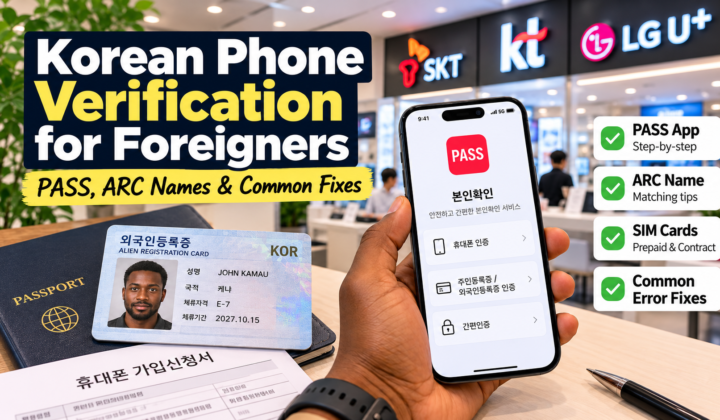
5. Get a Korean Phone Number Early
A Korean phone number quickly becomes more than a way to make calls. It is tied into identity verification for many local services, including banking, shopping, deliveries and apps.
A travel SIM or eSIM can be useful immediately after landing, but if you are moving here long term, you will eventually want a number properly registered to you. When you set it up, pay attention to how your name is entered. Small differences in name order, spaces or spelling can become surprisingly frustrating when one service tries to verify you against another.
6. Complete Your Residence Registration Steps
If your status requires foreign resident registration, make this one of your early administrative priorities. Your residence card becomes an important part of everyday life in Korea and is commonly used when setting up services.
The exact procedure, documents and deadlines depend on your immigration status, so verify the current requirements through Korean immigration rather than relying on a generic checklist. Once you receive your card, check that your personal information is correct and keep your registered address up to date when required.
7. Set Up Banking After Your Core Identification Is Ready
Opening a Korean bank account can be straightforward, but experiences vary between banks and even branches. Bring more documentation than you think you will need rather than making repeated trips.
Your passport, residence documentation, Korean phone number and proof related to your work, study or reason for staying may be relevant depending on the bank and account.
Once your account and phone verification are working together, life becomes noticeably easier. Transfers, online purchases, automatic payments and many local services start to feel much more normal.
8. Install the Apps That Make Korea Easier
You do not need fifty Korean apps on your first day. Start with the ones that solve immediate problems.
For navigation, get comfortable with Naver Map or KakaoMap. Add a translation tool such as Papago. Install the app for your bank once your account is ready. After that, you can gradually add shopping, delivery, transportation and government-service apps as you actually need them.
This is better than downloading everything recommended in a “top 30 Korea apps” list and then forgetting what half of them do.
9. Learn the Public Transportation Basics
Korea’s transportation system is one of the things that can make everyday life here remarkably convenient. In major cities, buses and subways cover a huge amount of daily travel, while KTX and SRT make longer intercity trips much easier.
Get a compatible transportation card, learn how transfers work in your area, and use a Korean navigation app to check the correct bus stop or subway exit. The exit number matters more than newcomers sometimes expect—a station can be large enough that choosing the wrong exit adds a surprisingly long walk.
10. Understand How Health Insurance Applies to You
Healthcare is something worth understanding before you actually need it. Korea’s National Health Insurance Service has separate guidance for foreign residents.
According to current NHIS guidance, foreigners working at covered workplaces are generally enrolled as employee insured persons, while many eligible foreign residents who are not employee insured become subject to mandatory health-insurance enrollment after residing in Korea for more than six months. Visa type and individual circumstances matter, so check your own eligibility directly with NHIS.
Also find a clinic, pharmacy and larger hospital near your home before you need one. Saving them in your map app takes five minutes and can remove a lot of stress later.
11. Learn the Rules for Trash and Recycling Where You Live
This is a small detail until you are standing outside your building with a bag of rubbish and no idea where it is supposed to go.
Korea separates general waste, food waste and recyclable materials, but the practical setup can vary by building and local government. Ask your landlord, real-estate agent, building manager or a neighbor how disposal works at your address.
Do not be embarrassed to ask. This is exactly the kind of everyday detail that takes a little time to learn.
12. Learn Enough Hangul to Make Daily Life Easier
You do not need fluent Korean before moving here. You also do not need to wait until you are fluent before using Korean.
Start with Hangul. Being able to read station names, apartment signs, menu items and basic labels makes Korea feel much less intimidating. Then learn the phrases you actually need in your own life rather than memorizing vocabulary you never use.
Translation apps are extremely helpful, but even basic Korean changes the way you experience the country.
13. Give Yourself Time to Build a Routine
There is a strange stage after moving abroad where simple things take too much mental energy. Buying the right rubbish bags, understanding a delivery message, finding the correct subway exit or explaining something at a bank can feel like a small project.
That stage passes.
Try not to judge your entire experience of Korea by your first difficult week. Build your routine one piece at a time. Once your phone, banking, transport, housing and everyday apps are working, the country starts feeling very different.
I explore more of that adjustment in Part 2: Settling Into Everyday Life in South Korea.
Your First-Weeks Checklist
- Confirm your visa and current immigration requirements.
- Prepare originals and copies of important documents.
- Arrange initial accommodation and understand your commute.
- Get temporary connectivity, then a long-term Korean phone number when eligible.
- Complete the residence-registration steps required for your status.
- Open a Korean bank account when your documents are ready.
- Install Naver Map or KakaoMap and a translation app.
- Get familiar with local buses, subways and transportation cards.
- Confirm how National Health Insurance applies to you.
- Find your nearest clinic, pharmacy and hospital.
- Ask how rubbish, food waste and recycling work at your address.
- Learn basic Hangul and a handful of phrases you will actually use.
A Final Thought Before You Move
You do not have to arrive in Korea knowing how everything works. Nobody does.
Prepare the important documents, confirm the rules that apply specifically to you, and then allow yourself to learn the rest by living here. Korea can feel intensely unfamiliar at first, but many of the systems that seem complicated in week one become ordinary surprisingly quickly.
That is what I want SmartKoreaGuide to help with—not simply telling you facts about Korea, but making the process of actually living here a little clearer.
Official resources worth bookmarking: Korea Immigration Service, Hi Korea, Korea Customs Service, and National Health Insurance Service.