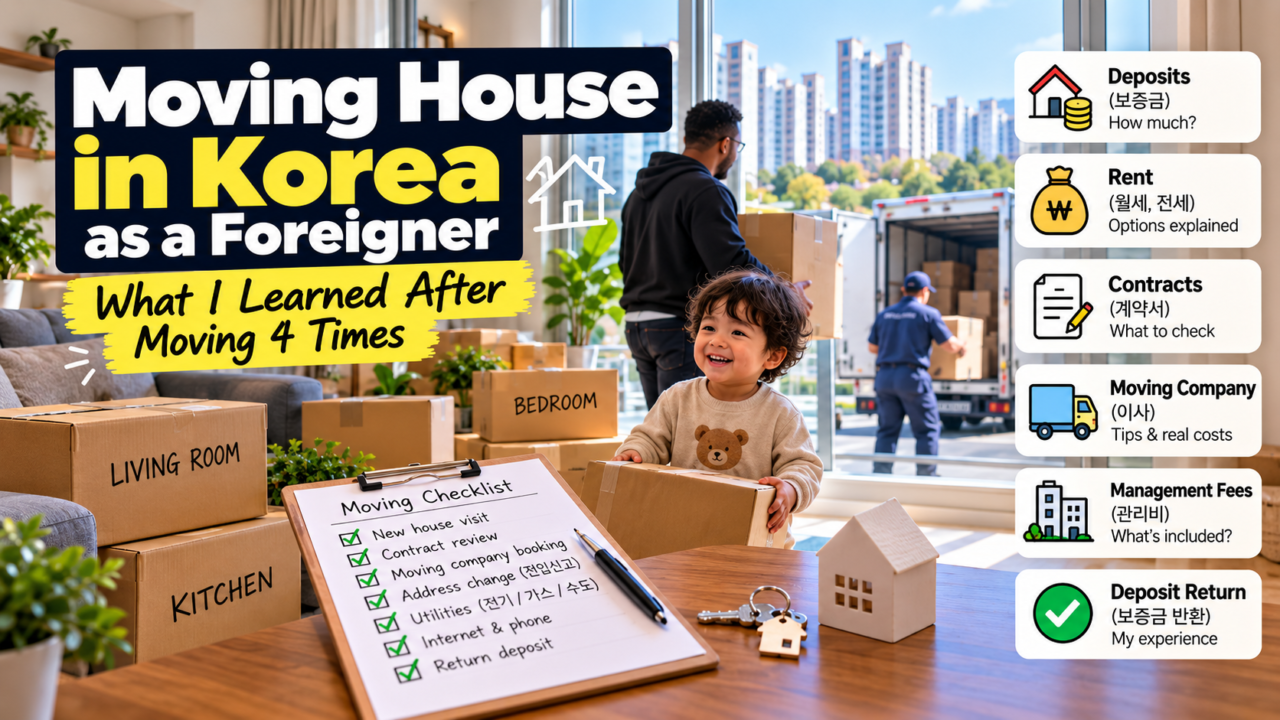
The hardest part of moving house in Korea has never been moving day for me. It happens earlier—when I finally find an apartment I like, the location works, the size feels right, and then I see how much cash I need for the deposit.
I have moved four times in Korea: Cheonan, Gwangmyeong, Gimpo and now Pyeongtaek. I have lived in company housing, officetels and an apartment. Strangely enough, after all those moves, packing boxes is probably the part I worry about least. Korea has taught me that the boxes are innocent. The deposit is the one you need to watch.
The bigger challenge has always been the same: Can I find the right home, in the right place, at a price I can afford—and do I have enough cash ready to secure it?
That is what I want to talk about here. Not a perfect checklist written from a distance, but what moving in Korea has actually been like for me.
The part nobody really prepared me for: the deposit
When I started renting for myself, I quickly learned that being able to afford the monthly rent does not necessarily mean you can afford the apartment.
I have always rented using 월세 (wolse), or monthly rent. My deposits have ranged from around ₩3 million to ₩20 million, while the monthly rent itself has ranged from roughly ₩500,000 to ₩1.2 million.
So there are really two numbers you need to think about. The first is what you can comfortably pay every month. The second—and sometimes more painful one—is how much cash you can put down right now. An apartment can look very affordable right up until the deposit casually asks for the contents of your savings account.
I never used jeonse because I simply did not have the huge amount of money needed upfront. Getting a bank loan large enough to make it work was also very difficult in my own experience as a foreigner. Someone else’s situation may be different, but for me, monthly rent was the realistic option.
If I were starting again, I would decide my maximum deposit before spending hours looking at apartments. It saves you from finding a place you love and then discovering that the upfront cash requirement puts it out of reach. If the Korean rental systems are still confusing, I explain them separately in my wolse vs jeonse guide.
Finding the house: where the real work starts
Once I know what I can actually spend, the hunt begins. This has usually been the most frustrating part for me—not because the apps are difficult, but because the perfect combination of price, space and location rarely appears all at once.
I normally searched using Korean real-estate platforms such as Naver Real Estate and Dabang. Once I found a listing I liked, I contacted the realtor directly using the details in the app. I did not personally have problems dealing with realtors, but being able to communicate in Korean helped a lot. Korean friends were also useful when I wanted a second opinion.
One thing I would strongly recommend is checking the location in person, not only the apartment. Look at the nearest bus stops or subway stations and think about your real commute. A cheaper apartment can become inconvenient very quickly if public transportation is poor and you do not have a car. My article on public transportation in South Korea can help with that part of the decision.
Found a good place? You may need to decide quickly
When I do find a place that ticks most of the boxes, there is another problem: sometimes you cannot think about it for three days. Good rentals can move quickly. I have paid a small pre-contract deposit to secure a property when I knew I wanted it. That creates a strange balance—you do not want to rush into a bad contract, but you also cannot assume a good apartment will patiently wait for you while you hold a family meeting, sleep on it and consult three group chats.
Before I pay, I want to know what I am getting into
Before signing, I always want to know whether there is unusual debt attached to the property that could become a problem if the home is foreclosed on or sold through auction. Most realtors will help obtain the relevant property information, but I still think it is worth double-checking rather than assuming everything is fine.
The brokerage fee also depends on the transaction value and property type rather than being one universal price. I usually checked the expected amount in advance using Korean calculators such as Naver’s brokerage-fee calculator.
The boring paperwork I would never skip
For my rental contracts, I obtained 확정일자 (hwakjeong-ilja) at the local 주민센터 (jumin senteo) / 행정복지센터 (haengjeong bokji senteo). My realtor explained why it matters: it can be important for protecting a tenant’s deposit if the property later enters foreclosure or auction proceedings.
The legal details around deposit protection are more complicated than simply saying that 확정일자 (hwakjeong-ilja) guarantees repayment, so I would not rely on it as your only protection. But it is an important administrative step for many tenants and one I have always taken seriously.
After the boxes are unpacked, immigration still needs your new address
After moving, foreign residents must report a change of place of stay. Current Government24 guidance says a registered foreigner can report the new address online or in person at the immigration office with jurisdiction over the new address, or at the new area’s city, county, district or local 주민센터 (jumin senteo). The current legal deadline is within 15 days of moving in.
For an in-person application, Government24 currently lists a passport or Foreign Resident Card plus proof of residence, such as a lease contract or other document showing that you actually live at the new address.
In my own moves, I have used both immigration offices and 주민센터 (jumin senteo) / 행정복지센터 (haengjeong bokji senteo) depending on my circumstances. I normally brought my lease contract and ARC. If you are unsure what applies to your visa or situation, confirm it before moving rather than waiting until the deadline.
If you are new to Korea, my Foreign Resident Card guide explains why the card becomes so important for everyday administration.
The building office can make or break moving morning
For officetels and apartments, I have always had to coordinate with the building management office before moving. Depending on the building, this may include reserving the elevator, booking the moving date, arranging access for the moving truck, paying an elevator or moving fee, registering the car, and collecting or returning access cards.
None of that is difficult. What you do not want is to discover it at 8 a.m. with a moving truck outside and a team waiting to use an elevator you were supposed to reserve three days ago. That is a very efficient way to become unpopular with both the movers and the management office before breakfast. I now contact the management office before moving day and get those small rules out of the way.
The biggest pleasant surprise: 포장이사 (pojang-isa)
One of the genuinely pleasant surprises for me has been 포장이사 (pojang-isa), the full-service packing and moving option. The first time you see how much they handle, it is impressive. The teams I used packed everything, transported it, helped with cleaning and then arranged the furniture and belongings in the new home.
They will often put the house together to the point where you can start living in it immediately. Of course, I normally rearrange things afterward because everyone has their own preference, but compared with packing and moving everything yourself, it takes a huge amount of stress out of moving day.
The price depends heavily on how much you own. I have used services such as 숨고 to request quotations. Movers typically visit the home, inspect the amount of furniture and belongings, and then give a final quotation.
I have not personally had serious problems with broken items. When damage was clearly the mover’s responsibility, the companies I dealt with were willing to discuss compensation. I would still confirm damage terms and insurance before booking rather than assume every company follows the same policy.
Before I hand back the keys, I want the bills clean
Before leaving the old property, I contact the utility providers and settle any remaining balances. For internet, I normally request a transfer to the new address instead of cancelling the service. A technician may need to visit the new property, and there may be a small transfer or installation charge depending on the provider and contract.
I also visit the management office so they can calculate the final 관리비 (gwanribi) balance. In my experience, it is important to settle everything cleanly before handing the property back. If you are unfamiliar with these charges, see my guide to Korean apartment management fees.
The deposit matters just as much when you leave
I have generally had good experiences with landlords. My deposit was returned after I handed over the keys and the landlord inspected the property. On one occasion, a small amount was deducted for minor damage, but I have never had a serious dispute over a deposit.
There are still several things I would tell any foreigner to do:
- If you want to leave before the contract ends, talk to the landlord early and check the termination conditions in your contract. In practice, finding a replacement tenant may be part of the solution, but your actual obligations depend on the contract and circumstances.
- If the contract is ending normally, give the landlord enough notice. A large deposit may require time for the landlord to arrange repayment.
- If there is minor damage you can reasonably repair, consider fixing it before the final inspection.
- If you made changes to the property without the landlord’s agreement, restore the property to its original condition before leaving where required.
- Take photos before you leave so you have a record of the property’s condition.
The small things I update once I am finally in
After moving, I update my postal address and shopping/delivery addresses first. Those are the ones that affect daily life immediately. I also inform services that need the new address where necessary.
For daycare, I simply informed the daycare that we had moved. Government records may be linked or shared differently depending on the service, so I would not assume every private or public account automatically updates just because you reported your new place of stay.
If I were moving again next week
About one week before moving
- Make sure your lease contracts and important documents are easy to access.
- Confirm the 포장이사 (pojang-isa) company and moving time.
- Notify the building management office and reserve the elevator/moving slot if required.
- Confirm how the final 관리비 (gwanribi) and utilities will be settled.
- Confirm deposit-return arrangements with the landlord.
On moving day
- Start early so the movers can work without unnecessary delays.
- Settle remaining management-office charges and utilities.
- Allow the landlord to inspect the old property.
- Hand over keys only when you understand how and when the deposit will be returned.
- Let the moving team place the furniture, then adjust the layout to your preference.
During the first week in the new home
- Report your new place of stay within the legal deadline.
- Complete any relevant rental-protection steps such as 확정일자 (hwakjeong-ilja) if applicable.
- Update postal and delivery addresses.
- Register vehicles and access cards with the management office.
- Check public transport routes, local shops, recycling points and building rules.
What I would tell a friend before they moved
If a friend told me they were about to start looking for a home in Korea, the first thing I would tell them would be: work out how much deposit you can realistically put down before you start falling in love with apartments.
If you do not have enough cash available, it can be difficult to get the house you want in the location you want when you want it. Once the money is prepared and you understand the process, I have found the rest of moving in Korea fairly well coordinated.
That does not mean every move will be easy, but after four moves, my experience has been that the system itself is manageable. The biggest challenge is matching your budget to the Korean rental market—and then making sure you protect your deposit and complete the administrative steps properly.
For a wider picture of monthly expenses, read my realistic cost of living guide for South Korea. If you are preparing for your first move to Korea rather than moving within the country, start with the Moving to South Korea checklist.
Official sources and verification
Administrative rules can change. For place-of-stay reporting, verify the latest requirements through Government24, HiKorea or your local immigration office/주민센터 (jumin senteo). As of September 2026, Government24 and Article 36 of the Immigration Act state that registered foreign residents should report a new place of stay within 15 days of moving in.