Opening a bank account in Korea is one of those jobs that sounds simple until you are actually sitting at the branch counter. In my experience, the account itself is rarely the confusing part. The real challenge is making sure your identification, Korean phone number and supporting documents all line up.
I have also learned not to assume that another foreigner’s experience will be exactly the same as mine. Requirements can vary by bank, branch, visa status and what you want to use the account for. Still, there are a few things I would prepare before walking into a Korean bank.
Start with your Foreign Resident Card
For someone settling in Korea long term, your Foreign Resident Card—still commonly called the ARC—is the piece of identification I would want in hand before trying to build my full banking setup.
Some banking situations may be possible with a passport or other identification, but do not assume that means every branch or digital service will work before your residence card arrives. Woori Bank, for example, says a passport or foreigner registration card can be accepted as identification and specifically tells customers who opened an account with a passport to bring both the passport and residence card once the card has been issued. citeturn0search0turn0search7
My practical advice: if your physical card has not arrived yet, ask the specific bank what it can do for you now and what will need to be updated later. I would not build an important salary, rent or payment setup around the assumption that a passport alone will unlock everything.
Bring proof of why you need the account
I would bring more than just ID. Banks may ask for supporting documents because they need to understand the purpose of the account and because of fraud-prevention rules.
Depending on your situation, useful documents can include:
- your passport and Foreign Resident Card;
- an employment certificate, employment contract or recent proof of salary;
- a lease agreement or another document showing your Korean address;
- student enrollment documents if you are studying; and
- other paperwork showing why you need the account.
This is not just theoretical. Woori’s current foreign-customer guidance says additional documents such as proof of employment, pay information, proof of income or a utility bill may be required depending on the transaction. citeturn0search0
I would rather carry one extra folder to the bank than lose another morning because one document was missing.
Your Korean phone number needs to match your identity
This is one of the details I think newcomers underestimate.
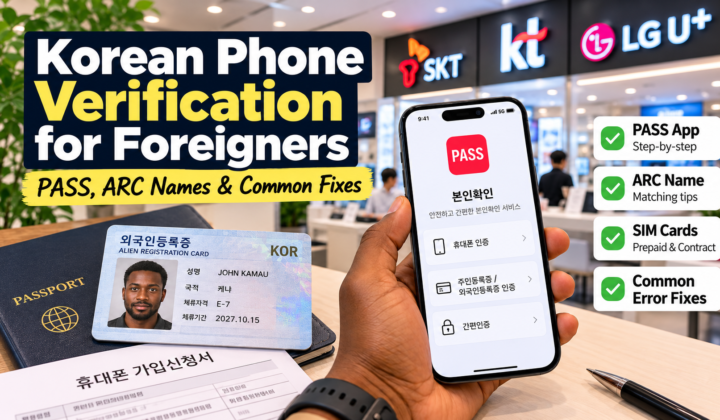
In Korea, your phone number often becomes part of your identity-verification system. That means the name and personal information registered with your mobile carrier need to match the information the bank is trying to verify.
If one system stores your name differently—different order, missing middle name, different spacing or another variation—you can end up with an account that works at the branch but fails when an app tries to authenticate you.
So when you get your Korean phone number, check how your name has been registered. If a banking app keeps rejecting your identity, do not immediately assume the app is broken. Compare the information held by your carrier, bank and residence card first.
Be prepared for a limited account
This is another surprise that can catch foreigners—and Koreans—off guard.
Your first account may be opened as a 한도제한계좌, or limited account. This is a fraud-prevention measure that restricts how much money can be transferred or withdrawn until the bank is satisfied about the account’s financial purpose.
You will sometimes see ₩1,000,000 quoted as the daily limit. Treat that as a common example rather than a universal rule across every bank and product. Woori currently states that one of its limited accounts has a ₩1 million daily withdrawal and transfer limit. citeturn0search8
This matters if you are expecting to immediately use the new account for a large housing payment, moving expenses or another substantial transfer.
How to get the account limit removed
If your account is restricted, ask the bank exactly what evidence it accepts to convert it to a normal account.
In practice, the goal is to prove that you have a legitimate reason for using the account. Depending on the bank and your circumstances, that might mean taking an employment certificate, salary evidence, utility bill, lease contract or another document connected to your regular financial activity.
Woori’s current guidance, for example, tells customers with a limited account to visit the account-managing branch with identification and proof of financial transaction purpose, such as a payslip, to request removal of the restriction. citeturn0search8
Do not wait until the day you need to make a large transfer. Check your transfer and ATM limits as soon as the account is opened.
Choosing a bank as a foreign resident
I would not choose a Korean bank purely because somebody online called it the “best bank for foreigners.” Your experience can depend heavily on the branch you visit and the services you actually need.
Major banks such as Hana, Shinhan and Woori are sensible places to compare, especially branches accustomed to international customers, foreign workers or students. Woori, for example, publishes dedicated foreign-customer guidance and operates a foreign-customer call center with support in multiple languages. citeturn0search0
When comparing banks, I would ask four practical questions: Can I comfortably use the mobile app? Can I receive my salary? What are my transfer limits? And how easy will international transfers be if I need them?
Digital banking is where the differences become obvious
Opening the physical account is only half the job. You also want mobile banking, authentication and transfers to work without repeated branch visits.
Foreign residents should be careful with online advice about which app “works for foreigners,” because eligibility can differ by product and can change. Some digital account-opening services are still restricted to Korean nationals. Woori’s current smartphone account-opening service, for example, states that it is for Korean nationals with a resident registration card or driver’s licence and that foreign customers cannot use that particular service. citeturn0search11
I would apply the same caution to Toss Bank and KakaoBank. Do not assume that because one feature or app accepts a foreign resident’s identification, every account or service does. Check the eligibility of the exact product you want before depending on it. For example, Toss Bank’s current foreign-currency account page is tied to having an eligible Toss Bank won account, while its published product guidance can impose nationality/residency requirements on specific products. citeturn0search4turn0search14
Do not judge an entire bank by one branch
This is something I would emphasize from experience living in Korea: two people can walk into different branches of the same bank and come away describing the process very differently.
Staff familiarity with foreign names, passports, residence cards and visa situations varies. If somebody tells you something cannot be done, politely ask what requirement is missing. Sometimes you need another document. Sometimes the product is genuinely unavailable. And sometimes another branch that regularly serves foreign residents simply understands the process better.
Set everything up before leaving the branch
Once the account is open, I would not rush out with only a bankbook or card.
Ask about:
- mobile and internet banking;
- your daily transfer and ATM limits;
- your debit/check card;
- authentication or OTP requirements;
- salary deposits;
- automatic bill payments; and
- international transfers if you expect to send money abroad.
Woori’s account-opening guidance, for example, notes that customers can apply for cash-card, internet-banking and phone-banking services as part of the account-opening process. citeturn0search7
My practical bank-account checklist
- Wait for your Foreign Resident Card where possible, or confirm what the bank can do before it arrives.
- Bring your passport as well as your residence card.
- Take proof of employment, study, address or financial purpose.
- Make sure your Korean phone registration matches your identity information.
- Ask whether the account is a 한도제한계좌.
- Write down the exact transfer and withdrawal limits.
- Ask what documents are needed to lift those limits.
- Set up mobile banking and authentication before leaving the branch.
- Check that your debit/check card and salary deposits are ready if you need them.
- If the process is unusually difficult, ask what is missing rather than assuming foreigners cannot get the service.
One last piece of advice
Banking in Korea becomes much easier once your residence card, Korean phone number and bank information all agree with each other. The first setup can feel unnecessarily complicated, but after those pieces are connected, everyday payments and transfers become much smoother.
If you are newly arriving in Korea, I recommend following the order in my moving-to-South-Korea checklist. You may also want to read my guide to getting a Korean phone number as a foreigner, because phone identity verification and banking are much more closely connected here than many newcomers expect.
Bank procedures, account limits and product eligibility can change and may vary by customer. Confirm the current requirements with the bank before relying on a specific limit or document list.
Having trouble verifying your identity? Read my guide to Korean phone verification for foreigners, including PASS, Residence Card name order and telecom registration.