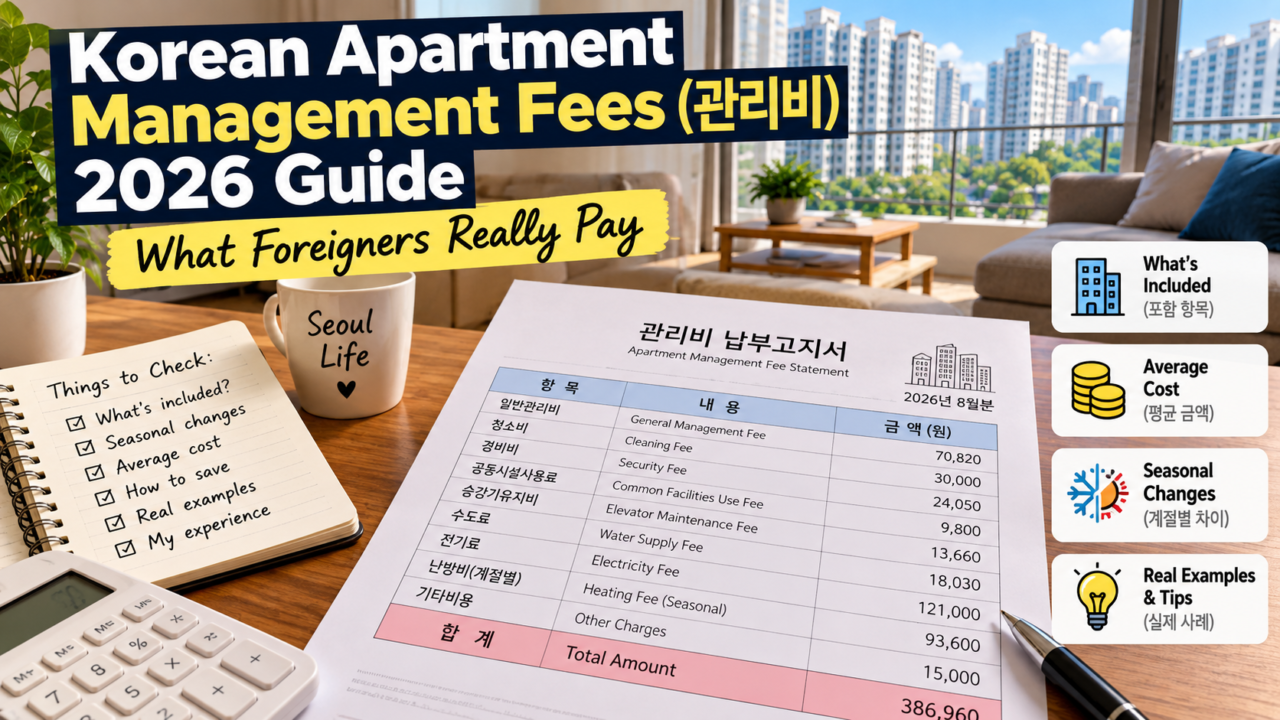
When you first look for an apartment in Korea, there are usually two numbers that get most of your attention:
The deposit.
And the rent.
Then you move in, survive your first month, open your mailbox and discover a third number waiting for you:
관리비 (gwanribi).
Welcome to Korean apartment management fees. 😄
I’ve lived in several types of housing in Korea over the years, from officetels to larger family apartments, and 관리비 is one of those expenses that looks simple until you actually start paying it.
What surprised me most wasn’t that management fees existed.
It was how much they could be — and how much they could change depending on the season.
Your realtor might tell you:
“The management fee should be around ₩200,000.”
That can be useful as a rough estimate.
But it does not necessarily mean your bill will be ₩200,000 every month.
Your actual cost depends on the building, apartment size, what is included in the bill and, importantly, how you live.
If you’re budgeting for an apartment in Korea, this is one bill you definitely shouldn’t ignore.
What exactly is 관리비?
관리비 (gwanribi) translates roughly to management or maintenance fees.
But thinking of it as simply “the building maintenance fee” can be misleading.
Depending on where you live, your monthly bill may include both shared building expenses and some or all of your household utilities.
Shared costs can include things such as security guards, cleaning, elevators, common-area electricity and general maintenance of the apartment complex.
Then you may also see charges related to your own household usage, including electricity, water or heating.
And this is where things get confusing:
관리비 is not structured exactly the same way everywhere.
In some places I lived, my utilities were billed separately.
In my current apartment, everything comes together on one bill, with the different charges broken down into sections.
So when someone tells you:
“My 관리비 is ₩150,000.”
That number doesn’t tell you very much unless you also know what is included in it.
The size and type of home matter
One thing I noticed immediately over the years is that my officetels were generally much cheaper to manage than the larger apartments I’ve lived in.
That makes sense.
A larger apartment complex usually has more things that need to be maintained.
There may be security guards, cleaners, multiple elevators, landscaping, underground parking, communal facilities and more shared areas.
All of that costs money.
Apartment size also affects the base management fee.
So even before your personal electricity, heating or water usage enters the equation, someone living in a larger apartment may already be starting with a higher base charge.
This is why you shouldn’t compare 관리비 by looking at the headline number alone.
A ₩120,000 officetel bill and a ₩300,000 family-apartment bill may be paying for very different things.
My current bill: one statement, many charges
In my current apartment, I receive one management bill showing the different sections clearly.
Personally, I prefer this.
Instead of having several different bills arriving independently, I can see how much we used and where the money is going.
But it also makes one thing very obvious:
your personal habits can move the total bill quite a lot.
During mild weather, our costs are relatively predictable.
Summer?
Different story.
Summer: my air conditioner attacks the electricity bill
During the Korean summer, I run the air conditioner a lot.
And when I say a lot, I mean a lot. 😂
So at the moment, electricity is one of the largest usage-related sections on our management bill.
This is why I wouldn’t use one month’s 관리비 to estimate the entire year.
Someone might show you a spring bill and everything looks wonderful.
Then July and August arrive.
Suddenly your apartment has apparently developed expensive taste.
Our overall management fees and utilities are usually around ₩350,000 per month, but during peak summer or winter they can climb toward roughly ₩450,000.
Your numbers will obviously depend on the apartment and your household.
The important lesson is the seasonal change.
Winter: floor heating can change the calculation
Winter has the opposite problem.
Instead of air conditioning, you’re dealing with heating.
Many Korean apartments use floor heating, commonly associated with the traditional 온돌 (ondol) heating system.
Depending on the building, the cost may appear differently on your bill.
In some of the places I’ve lived, heating was effectively reflected through the gas bill.
In my current apartment, it appears as its own heating charge.
So if you’re comparing two homes, ask what heating system the building uses and how it is billed.
I would pay especially close attention when considering an older apartment.
From my own experience, older apartments can sometimes become noticeably more expensive to heat during winter.
I wouldn’t assume every old apartment is expensive, but I would absolutely ask to see a winter bill before signing if one is available.
A warm apartment is wonderful.
Discovering in January how much that warmth costs is slightly less wonderful.
Don’t take the realtor’s estimate too literally
Whenever I’ve been apartment hunting, real-estate agents usually gave me a rough idea of what 관리비 would cost.
That estimate is still useful.
The base amounts within a building tend to be somewhat predictable.
But nobody can tell you exactly what your future bill will be.
They don’t know whether you’ll run your air conditioner all day.
They don’t know how warm you like the apartment in January.
They don’t know how much water your household will use.
In my case, I usually only understood the true monthly amount after I had moved in and started receiving my own bills.
So before signing, I would ask the realtor:
“Can I see a recent 관리비 bill for this apartment?”
Even better, ask whether you can see one from summer and one from winter.
That gives you a much more realistic picture than hearing:
“Usually around ₩200,000.”
There are charges you may not recognize
The first time you look closely at a Korean management bill, don’t be surprised if some of the terminology makes absolutely no sense.
Even after living here for years, I’ve still encountered items that made me stop and ask:
“What exactly am I paying for here?”
One of those for me was:
장기수선충당금 (janggi susun chungdanggeum)
The name is almost long enough to justify charging you for reading it. 😂
In simple terms, this is a long-term repair reserve used for major repair and replacement work involving shared parts of an apartment complex.
Think of the large expenses that eventually come with maintaining a building over many years.
And this particular charge is especially important for renters.
Renters: don’t forget your 장기수선충당금 when moving out
This is one of the most useful things I’ve learned from actually renting apartments in Korea.
When I moved out of one apartment, I went to the management office and asked them to calculate how much 장기수선충당금 I had paid during the period I lived there.
They calculated the total and gave me a receipt.
I took that receipt to my landlord.
The landlord then reimbursed me for the full amount stated on the document.
Under Korea’s 공동주택관리법 시행령 (gongdong jutaek gwanribeop sihaengnyeong, Enforcement Decree of the Multi-Family Housing Management Act), if the occupant has paid the long-term repair reserve on behalf of the owner, the owner must return that amount. The management body must also issue confirmation of those payments when the occupant requests it. National Law Information Center
So if you’re renting and you see 장기수선충당금 on your management bill:
Don’t just forget about it when you move out.
Ask the management office for the payment record.
Over a long tenancy, those monthly amounts can add up.
You can check management fees before moving in
There’s another tool foreigners should know about: K-apt (공동주택관리정보시스템).
K-apt is Korea’s apartment-management information system. It publishes management-fee information for covered apartment complexes and lets users inspect and compare fee data between complexes.
Since October 25, 2024, the K-apt management-fee disclosure requirement has expanded to include non-mandatory-management apartment complexes with 100 or more households. K-apt
That doesn’t mean the number you find online will perfectly predict your own bill.
Actual household charges still depend on the building, heating setup, apartment size and your own usage.
But it’s an excellent additional check.
If you’re comparing two apartment complexes, don’t just compare the rent.
Compare the management costs too.
What I would ask before signing a Korean apartment lease
If I were renting another apartment tomorrow, these are the questions I’d ask before signing:
- What exactly is included in 관리비?
- What is the normal monthly estimate?
- Can I see a recent actual bill?
- Can I see a summer or winter bill as well?
- How is heating charged — separately, through gas or inside the management bill?
- Does the bill include 장기수선충당금?
- If the apartment is older, what are typical winter heating costs?
Those questions take a few minutes.
But they can save you from discovering after moving in that your “cheap apartment” isn’t quite as cheap as it looked.
Don’t compare rent without comparing 관리비
This is probably the biggest lesson.
Imagine Apartment A costs:
₩900,000 rent + ₩150,000 관리비
And Apartment B costs:
₩850,000 rent + ₩350,000 관리비
Apartment B looked cheaper when you clicked the listing.
It isn’t cheaper anymore.
That’s why whenever I compare housing costs in Korea now, I think about the full monthly housing cost, not just rent.
Deposit matters.
월세 (wolse, monthly rent) matters.
관리비 matters.
Utilities matter.
Parking may matter.
Transport to work matters.
The number that matters is the one your bank account actually experiences at the end of the month.
If you’re still learning how Korean rental contracts work, my Wolse vs Jeonse guide explains the two main rental structures, deposits and the questions you should ask before signing.
And if you’re trying to work out how much you actually need to live here, my Cost of Living in Korea 2026 guide breaks down my own expenses from student life through to raising a family in Korea.
If you’re preparing for a move, my moving-house guide covers the practical steps I learned after moving several times in Korea.
Final thought
관리비 isn’t something to be scared of.
Most of the time, once you understand your building and receive a few bills, it becomes just another normal monthly expense.
The mistake is ignoring it when choosing the apartment.
Ask what’s included.
Ask for an estimate.
Look at an actual bill if possible.
Check the heating system.
And when you eventually move out, remember that frighteningly long Korean word:
장기수선충당금.
Because that one might actually give you some money back. 😄