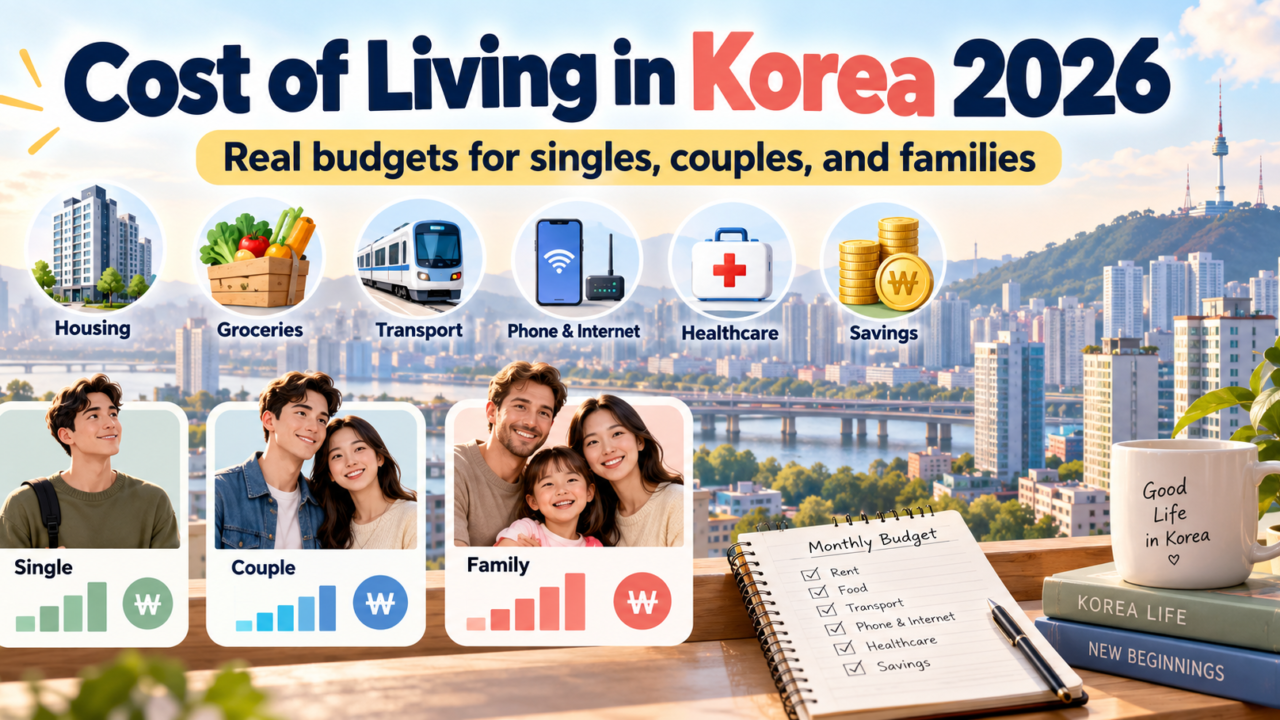
If you search for the cost of living in Korea, you’ll usually get a neat table telling you how much rent, groceries and transportation supposedly cost.
The problem?
Real life is rarely that neat.
I moved to Korea from Kenya in 2010, and over the years I’ve lived here as a university student, a single office worker, a guy spending too much money on weekends in Hongdae and Itaewon, a boyfriend travelling between cities every weekend, a husband, and now a father.
My expenses changed at every stage.
And if there is one thing I’ve learned after around 16 years in Korea, it’s this:
Korea can be expensive, but a huge part of your cost of living depends on how you choose to live — and how much you earn.
If you live within your means, Korea can actually be a fairly reasonable place to live.
A quick note about the numbers: The older prices in this article are what I personally paid at the time. I’ve included separate 2026 references later so you don’t see my ₩350,000 rent from 2016 and immediately start packing your bags for Cheonan. 😄
For rough USD conversions, I’m using approximately ₩1,360 = US$1, close to the market rate reported on October 1, 2026. Reuters
My cost of living journey in Korea
Here’s the quick version before we get into the details.
| Year | Life stage | Location | Housing | Approx. spending |
|---|---|---|---|---|
| 2010 | University student | Cheonan | University dorm, scholarship covered housing | Usually ~₩1.2M/month ($880), excluding housing |
| 2015 | First job | Company housing | Rent-free 3-bedroom shared with 2 colleagues | Utilities were ~₩180k total, ~₩60k each |
| 2016 | Single, living alone | Cheonan | ₩3M deposit + ₩350k rent | ~₩1.5M/month ($1,100) total |
| 2018 | Living alone | Gwangmyeong | ₩10M deposit + ₩560k rent | Costs gradually increased |
| 2019 | Dating | Different cities | Same home | ~₩100k most weekends together |
| 2021 | Married | Gwangmyeong | Wife moved into my officetel | ~₩2M–₩3M/month |
| 2022–23 | Family life begins | Gimpo | ₩10M deposit + ₩750k rent | ~₩2M–₩3M/month |
| 2024–26 | Family of three | Pyeongtaek | ₩10M deposit + ₩1.2M rent | ~₩4M/month ($2,940) |
That progression is exactly why I don’t like articles claiming that “you need X amount to live in Korea.”
Which version of you are we talking about?
Single me and married-with-a-child me have very different definitions of a normal Saturday.
Student life: cheap housing did not mean I was cheap
When I arrived in Cheonan in 2010, I was fortunate enough to be studying on a scholarship.
I lived in a normal university dormitory, and the school covered my accommodation.
That gave me a huge advantage because housing is usually one of the largest costs when moving to Korea.
Even without rent, though, I could still spend around ₩1.2M ($880) during a typical month, mostly on food, transport, my phone, entertainment and trips.
A particularly enthusiastic month could reach around ₩1.6M ($1,175).
So yes, apparently I discovered lifestyle inflation before I discovered income. 😂
First job: company housing was basically a financial cheat code
After graduating, I started my first job in 2015.
The company provided a three-bedroom apartment that I shared with two roommates.
Rent?
₩0.
We only had to pay utilities.
The total utilities were roughly ₩180,000 per month, meaning my share was around ₩60,000 ($44).
Lunch was also provided at work.
I still spent about ₩600,000 on food and around ₩1.2M on transport, phone, entertainment and other personal expenses.
Looking back, this was probably the perfect opportunity to save aggressively.
Did younger me do that?
Of course not.
Younger me had a strong YOLO investment strategy, where the main asset class was apparently “having fun.” 😂
2016: my first real independent budget
In 2016 I moved into my first officetel in Cheonan.
This was the first time I was personally responsible for a housing deposit and monthly rent.
| Expense | What I paid |
|---|---|
| Deposit | ₩3M (~$2,200) |
| Monthly rent | ₩350k (~$257) |
| Management fees + utilities | ₩100k–₩150k |
| Approx. total monthly spending | ~₩1.5M (~$1,100) |
I rarely cooked.
Lunch was covered by work, and dinner usually cost me around ₩6,000–₩8,000 if I ate out.
On the days I didn’t feel like going anywhere, my luxury dining experience consisted of cup ramyeon, a bowl of rice and a movie.
Honestly? Still a solid evening.
I also bought my first used car that year.
The car itself cost ₩9M, but after taxes and insurance, the real cost was closer to ₩11M ($8,100).
Fuel was roughly ₩120,000 per month.
That taught me an important lesson about Korean car ownership: the number written on the car listing is not necessarily the number your bank account eventually experiences.
Then I started dating… and the budget noticed
By 2019, my future wife and I were living in different cities.
We met almost every weekend, which meant driving, eating out, cafés and activities.
A normal weekend together cost around ₩100,000, depending on what we did.
So dating added roughly ₩400,000 per month to my lifestyle.
Worth it, obviously.
But romance apparently has a monthly subscription fee. 😄
Before dating, I was also going out roughly once during the week and spending some weekends clubbing in Hongdae or Itaewon.
A weekday night out could cost ₩50,000–₩60,000, while a clubbing weekend was roughly ₩100,000 including transport.
This is also the period where I wish I had followed one very simple rule:
Use a budget and save more.
Today I save and invest first, then live according to a monthly budget.
Very different strategy.
Much fewer 2 a.m. financial decisions.
Married life: Gwangmyeong
I moved to Gwangmyeong in 2018 and eventually got married in 2021.
My wife moved into the small officetel I was already renting.
Housing was:
₩10M deposit + ₩560,000 monthly rent + around ₩200,000 in management fees and utilities.
We didn’t cook much at first.
Eating out and delivery were still regular features of our life, and we spent roughly ₩500,000 per month on food.
Our overall household spending was around ₩2M–₩3M per month.
If you’re interested in how deposits, 월세 (wolse) and housing contracts work, read my Wolse vs Jeonse guide and my guide to Korean apartment management fees.
Gimpo: bigger house, then a baby
In 2022 we moved to a larger home in Gimpo.
Our deposit stayed at ₩10M, but rent increased to ₩750,000, with another roughly ₩200,000 for management fees and utilities.
Then our son was born in 2023.
And suddenly there was a small new member of the household with absolutely no interest in our budget.
Our food spending rose to around ₩800,000 per month, although we also started cooking at home much more.
At the time, because of our family circumstances and our son’s eligibility, we received a monthly child-support payment of around ₩1.1M during his first year, which later dropped to about ₩600,000.
That helped enormously.
Child-support programs and eligibility change, though, so I would never build a future budget around those historical numbers without checking the current rules.
Our current Pyeongtaek budget
In 2024 we moved again, this time to Pyeongtaek.
Our current apartment is 33평 — roughly 109 m² — with three bedrooms and two bathrooms.
Housing now costs:
₩10M deposit + ₩1.2M monthly rent + around ₩350,000 in management fees and utilities.
During peak summer air-conditioning or winter heating periods, those housing-related bills can rise to roughly ₩450,000.
Our total family spending today is about ₩4M per month ($2,940) before savings and investments.
I would describe our lifestyle as fairly modest, and there are definitely expenses we could cut if necessary.
That ₩4M also includes around ₩700,000 in monthly payments for our two EVs, so don’t assume every family needs the same budget.
Do you actually need a car in Korea?
Not necessarily.
If you live close to good subway and bus connections, I think owning a car is optional.
Korea’s public transportation system can make car ownership unnecessary in many cities.
Once you move farther away from major public transport — especially more rural areas — the calculation changes.
For us, switching to EVs reduced our running costs considerably.
Charging both cars costs around ₩150,000 per month, and highway tolls average roughly ₩50,000, depending on how much we travel.
Our annual insurance is approximately ₩600,000 for me and ₩700,000 for my wife.
Insurance prices vary significantly depending on age and driving history.
You can read my public transportation guide if you’re deciding whether you actually need a car.
Food: this is where lifestyle can quietly destroy your budget
Our family currently spends around ₩800,000 per month on food.
What feels expensive to me now?
Groceries, clothing and beef.
Beef in particular has personally offended my wallet on several occasions. 😭
Eating out has also become noticeably more expensive over my years here. In August 2026, dining-out prices nationally were 2.7% higher than a year earlier, and Korean media have reported more workers bringing lunch because a basic lunch plus coffee can easily push toward ₩20,000. Korea Times
Then there is delivery.
Korea is ridiculously convenient.
And convenience is dangerous.
Food, groceries, clothes and random things you suddenly decide you “need” can be at your door incredibly quickly.
Without a budget, those small purchases can quietly form their own economy.
Phone and internet
When I was single, I used to pay around ₩110,000 per month for my phone, plus roughly ₩20,000 for home internet.
| Service | Monthly cost |
|---|---|
| My phone | ~₩70k |
| Wife’s phone | ~₩30k |
| Internet + TV | ~₩50k |
| Total | ~₩150k |
There are cheaper options, especially 알뜰폰 (aldeulpon, budget mobile/MVNO plans).
I cover that in much more detail in my Korean phone-number and mobile-plan guide.
Healthcare is still one of Korea’s best-value expenses for me
Compared with many Western countries, healthcare is one area where I still think Korea offers excellent value if you have appropriate insurance coverage.
In my own experience, simple treatment has sometimes cost only ₩2,000–₩10,000 out of pocket.
More complex treatment has cost me around ₩300,000, while a surgery involving roughly a week in hospital cost around ₩4M ($2,940) upfront.
My private insurance later reimbursed part of those costs.
Those are my personal examples, not guaranteed prices.
If you’re new here, read my healthcare in South Korea for foreigners guide rather than assuming every hospital visit will cost the same.
Seoul vs Pyeongtaek vs Cheonan in 2026
Housing is where location changes everything.
For a small one-person home, Seoul’s August 2026 average rent for a small villa/multiplex studio under 33 m² was about ₩670,000 per month based on a standardized ₩10M deposit, while the average Seoul officetel rent was approximately ₩956,000. Maeil Business Newspaper
Current Pyeongtaek examples show small units roughly around ₩390k–₩500k per month, while recent Cheonan studio listings sit around ₩300k–₩500k, generally with much smaller deposits than Seoul. Mustard Data
For families, deposits make comparisons messy, but current examples show the scale:
| 2026 housing example | Seoul | Pyeongtaek | Cheonan |
|---|---|---|---|
| Small one-person unit | ~₩670k–₩960k+ | ~₩390k–₩500k | ~₩300k–₩500k |
| Family-sized 3-bedroom | ~₩1M–₩3M+ depending heavily on deposit/location | ~₩800k–₩1M+ in several current examples | ~₩600k–₩1M+, premium newer units higher |
Recent Pyeongtaek listings include three-bedroom apartments around ₩800,000/month with ₩20M–₩30M deposits, while Cheonan examples range from about ₩600,000/month with a ₩20M deposit to ₩1M or more depending on building age and location. Seoul’s 84 m² market is far more deposit-sensitive: recent examples range from around ₩1M monthly in older outer districts to well over ₩2M–₩3M for some newer properties. Zigbang
That is why I generally recommend considering life outside Seoul if your budget is tight.
Seoul is fantastic.
But Seoul also knows it is fantastic and charges accordingly.
How I would budget my income
Rather than telling everyone they need exactly ₩2M, ₩3M or ₩5M per month, I prefer percentages.
- Housing + utilities: maximum 20% of take-home pay
- Food: 15%
- Transport: 10%
- Phone + internet: 5%
- Fun: 5–10%
- Savings/investing: 30%
- Emergency fund: 10%
In Seoul, keeping housing below 20% may require roommates.
If you really want your own place, I would consider 30% an upper target, but once housing starts consuming much more than that, I would seriously look outside Seoul.
My priority today is very different from my single days:
save and invest first, then spend according to the monthly budget.
What I would budget in Korea today
These are not official averages — just practical starting ranges based on my experience and current housing examples.
| Household | Outside Seoul | Seoul |
|---|---|---|
| Single person | ~₩1.5M–₩2M/month | ~₩2M–₩3M+ |
| Couple | ~₩2M–₩3M | ~₩3M–₩4M+ |
| Family with one child | ~₩3M–₩4M+ | ~₩4M–₩5M+ |
Cars can push those figures higher.
Living near public transport can pull them lower.
Lifestyle can completely destroy the table.
How much should you bring when moving to Korea?
Personally, I would want at least ₩10M — roughly $7,350 — available when moving here.
If your employer provides housing, that gives you a very healthy cushion for food, transport, phone setup, household items and emergencies.
If housing isn’t provided, ₩10M gives you a reasonable starting point for a rental deposit.
For more detail on the expensive and slightly stressful art of physically changing homes here, read my Moving House in Korea guide.
So, is Korea expensive in 2026?
It can be.
But I don’t think “Is Korea expensive?” is actually the right question.
The better question is:
“Is the lifestyle I want affordable on the income I have?”
When I was younger, I barely budgeted and spent almost everything.
If I could go back and talk to the 2016 version of myself sitting in his Cheonan officetel with ramyeon, rice and a movie, I’d tell him two things:
Use a budget. Save more.
Today I spend more in absolute terms than I did when I was single, but my money has much more direction.
I have a family, a larger home and different priorities.
And instead of asking what else I can buy this month, I’m much more interested in what I can save and invest for the future.
That, more than inflation, has probably been the biggest change in my cost of living in Korea.
Not the country.
Me.