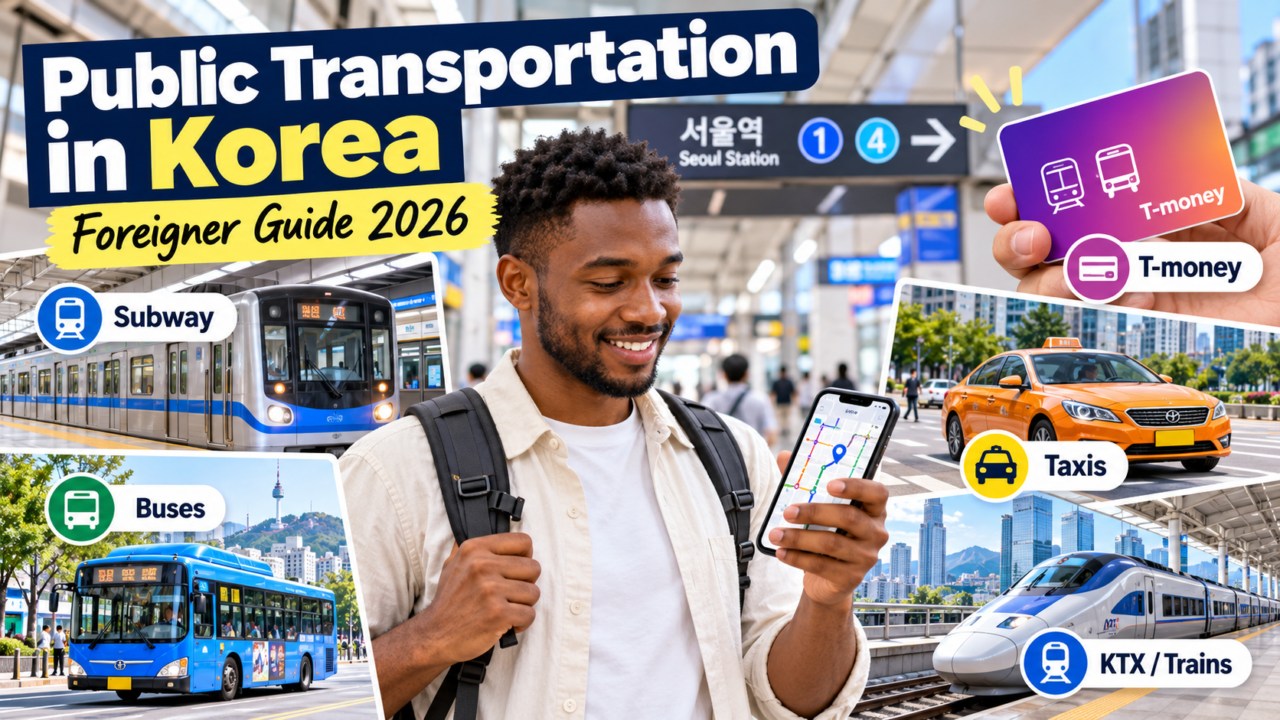
One of the things South Korea does extremely well is public transportation.
But there is one important detail that often gets lost when people say, “You don’t need a car in Korea.”
That statement is very true if you live in Seoul. Outside Seoul? Well… that depends.
I’ve lived in several Korean cities over the years, including Seoul, Suwon, Cheonan, Gwangmyeong, Gimpo and Pyeongtaek, and the difference in transport access can be surprisingly large. In Seoul, I’d go as far as saying a car can sometimes feel almost unnecessary. In places like Gimpo or Pyeongtaek, however, owning one can make a huge difference depending on exactly where you live and work.
Here’s what I’ve learned from actually commuting, travelling and raising a family here.
Seoul is probably the easiest place in Korea to live without a car
If you live in Seoul, the 지하철 (jihacheol — subway) network changes everything.
Between the subway and buses, you can reach most places without thinking too much about owning a car. In fact, having a car in Seoul comes with its own problems: traffic is one, and parking is another.
Honestly, parking in Seoul can be hell. 😅
There have been plenty of times when I would rather take the subway than drive simply because I know finding parking at the destination is going to be a headache.
The situation changes fairly quickly once you move farther outside Seoul. If you are considering that move, my guide to living outside Seoul goes into the housing and commuting trade-offs in more detail.
Distance on the map doesn’t tell the whole story
This is probably one of the biggest lessons I’ve learned from commuting in Korea.
When I lived in Gimpo and worked around Gasan Digital Complex in Seoul, driving to work took me about one hour when I left early enough to avoid the worst traffic.
Public transportation was technically available. The problem was the number of commuters and transfers. Taking public transport could push the journey close to two hours.
So yes, there was a subway route. But having a subway route on a map and having a convenient commute are two very different things.
I see the same problem where I live now. I commute from Pyeongtaek to Jinwi. On a map, the distance doesn’t look particularly dramatic. But because of the poor public-transport connections between my home and workplace, commuting by public transport is simply impractical for me.
I drive.
That’s why I always recommend checking the actual route, not just how close two places look geographically.
The most important thing to check before renting an apartment
If you plan to rely on public transport, don’t just ask:
“Is there a subway station nearby?”
Check the whole commute.
- Distance to the nearest subway station
- Distance to nearby bus stops
- How many transfers you’ll need
- Total estimated commute time
The transfer count is particularly easy to overlook.
From my experience, one or two transfers is reasonable. Once you’re regularly doing three or more, the commute starts becoming tiring very quickly.
And you don’t even need to guess. Put your future home and workplace into Naver Map and simulate the journey around the same time you’d normally commute.
A house that looks perfect on paper can suddenly become much less attractive when Naver Map tells you:
“Congratulations. Your morning commute includes three buses, two trains and a small spiritual journey.”
If you’re house-hunting, also see my moving house in Korea guide before signing anything.
Korea’s subway system is much easier than it first looks
When you first see a Seoul subway map, it can look like somebody dropped a bowl of multicolored spaghetti onto a map.
Don’t panic.
Once you start using it, the system is actually quite straightforward. Apps such as Kakao Subway and Naver Map make things much easier, and both are usable in English.
The biggest challenge for me wasn’t understanding the subway. It was rush hour.
During commuting hours, trains can get extremely crowded.
My biggest tip for newcomers is surprisingly simple:
Check the direction before you board
Don’t just find the correct line. Check which direction the train is travelling and which station is coming next.
I learned this the traditional way: by confidently boarding a train going in completely the wrong direction.
Nothing teaches subway navigation quite as effectively as watching your destination get farther away with every station. 😅
Which transportation apps should foreigners install?
If I were helping somebody set up their phone on their first day in Korea, I wouldn’t tell them to download twenty different apps.
For someone living in Seoul, I’d start with:
- Naver Map or KakaoMap — navigation and public-transport routes
- Kakao Subway — subway routes and train information
- A local bus app — bus arrival information
- Kakao T — taxis
Outside Seoul, I would add a train-booking app as well.
Google Maps works okay in Korea and is perfectly fine for general orientation, but I personally find the Korean apps much better when I need detailed local transit information.
I’ve also put together a broader list of essential apps for living in Korea.
Start with a physical T-money card
For tourists and people who have just arrived, a physical T-money card is probably the easiest place to start.
You can buy one at many convenience stores and transport locations, load money onto it, and use it for buses and subways. T-money’s current guidance confirms that physical cards can be topped up at convenience stores and subway stations, although some top-up machines may require cash.
For newcomers, I still recommend the physical card because it keeps things simple.
Once I became more established in Korea, however, I switched to using a Korean credit card with transportation functionality. That’s much more convenient for me because I don’t have to keep checking whether my transit card needs recharging.
So my general recommendation is:
Visiting Korea or newly arrived → T-money
Living here long-term → consider a Korean credit/debit card with transit functionality
Seoul’s official transport guidance also lists both prepaid cards and deferred-payment credit/debit cards as accepted public-transport payment methods.
Remember to tap when you get off the bus
Korean buses are generally straightforward once you get used to them.
You tap your transport card when boarding and should also tap when getting off. This matters especially when you’re using transfer discounts.
Seoul’s integrated public-transport system requires passengers to tap when exiting for transfer fares to calculate properly. The city currently says transfers generally need to be made within 30 minutes, with a longer window at night.
Modern navigation apps also make buses much easier because you can see your route and upcoming stops instead of desperately staring through the window hoping you recognise something.
We’ve all been there.
Taxis are easy — until everybody wants one
For taxis, I normally use Kakao T.
You enter where you are and where you want to go, and the driver comes to your location. That removes a lot of the communication problems foreigners used to face.
Normally, getting a taxi is fairly easy. The difficult times are predictable: rush hour, rainy days, holidays and late nights.
When everybody suddenly decides they need a taxi at the same time, the apps can become a waiting game.
Knowing a few Korean phrases also helps. One particularly useful phrase is:
여기서 내려 주세요
yeogiseo naeryeo juseyo
“Please drop me off here.”
Even basic greetings make the ride feel much more comfortable.
One taxi warning I would give foreigners
Pay attention to the fare, particularly around busy tourist areas.
If you are taking a standard Seoul taxi, check that the meter is running. Seoul’s official taxi guidance says standard taxis must normally charge by the meter unless an approved alternative fare system applies.
Late-night taxis also cost more. In Seoul, official late-night surcharges currently apply between 10 PM and 4 AM, with the highest standard sedan-taxi surcharge during the 11 PM–2 AM period.
That means the comfortable taxi ride home after missing the last subway may come with a little financial punishment for your poor time management.
I’ve paid that tuition before.
What if the subway has stopped running?
I normally do one of two things:
take a taxi, or plan the night around the last train.
If you’re going out somewhere unfamiliar, checking the last train before the evening starts is a very good habit.
Otherwise you may discover at 12:30 AM that your cheap subway trip home has transformed itself into a late-night taxi fare.
KTX and long-distance trains
Korea’s train network makes travelling between cities relatively easy.
Tickets can be bought online or at train stations, and in my experience trains are generally very punctual unless something unusual happens.
The important lesson is book early for weekends.
During weekdays, I’ve generally found it fairly easy to get a ticket. Once Friday arrives, popular trains can fill up quickly. Major holidays can be another story entirely.
Important 2026 SRT change
If you’ve read older Korea travel guides, you’ll probably see KTX and SRT described as separate high-speed rail systems with separate booking apps.
That information is now outdated.
From September 1, 2026, high-speed services that previously used the SRT booking system were integrated into KORAIL. SR’s official notice says the SRT app and website stopped being the main high-speed booking channels after August 31, and Suseo high-speed services can now be booked through KORAIL+, the KORAIL website, station counters and supported external booking services.
That’s exactly why checking current information matters in Korea — apps and systems change surprisingly quickly.
Don’t forget intercity and express buses
When train tickets are sold out, buses can be an excellent alternative.
Korea’s express and intercity bus networks reach places where rail isn’t always convenient. One advantage is that parts of the highway system have dedicated bus lanes, which can help buses move through heavy traffic more efficiently.
That said, don’t assume buses magically escape holiday travel. During major Korean holidays, bus tickets can also sell out and highways can become extremely busy.
My rule is simple:
Holiday trip? Book first. Make plans second.
Travelling with a young child changes the equation
When travelling as a family, we tend to drive.
Public transportation in Korea is excellent, but travelling with a young child means carrying more things, dealing with naps, changing plans unexpectedly and occasionally negotiating with a tiny human who has decided transportation itself is unacceptable.
A car gives us flexibility.
But even when driving, I sometimes choose public transportation for Seoul.
For example, when travelling from Pyeongtaek to Seoul, I would seriously consider the train, subway or bus if I know the destination has limited parking.
Because once again:
parking in Seoul is hell.
Sometimes the train isn’t just the cheaper option. It’s the option that preserves your sanity.
So, do you actually need a car in Korea?
My answer after living here for years is:
It depends entirely on where you live.
If you’re living in central Seoul with good subway access, you can comfortably live without a car. In fact, you may prefer it.
If you’re living farther outside Seoul — especially in areas where your home and workplace aren’t connected well by subway or bus — the situation can be completely different.
That’s why I wouldn’t decide whether I need a car based on the city name alone.
Check the exact commute. Look at the station. Look at the buses. Count the transfers. Check the travel time.
Because in Korea, 20 kilometres with one subway line can be much easier than 10 kilometres with three transfers.
And that is something a map alone doesn’t always tell you.
If you’re still planning your move, these guides may also help: