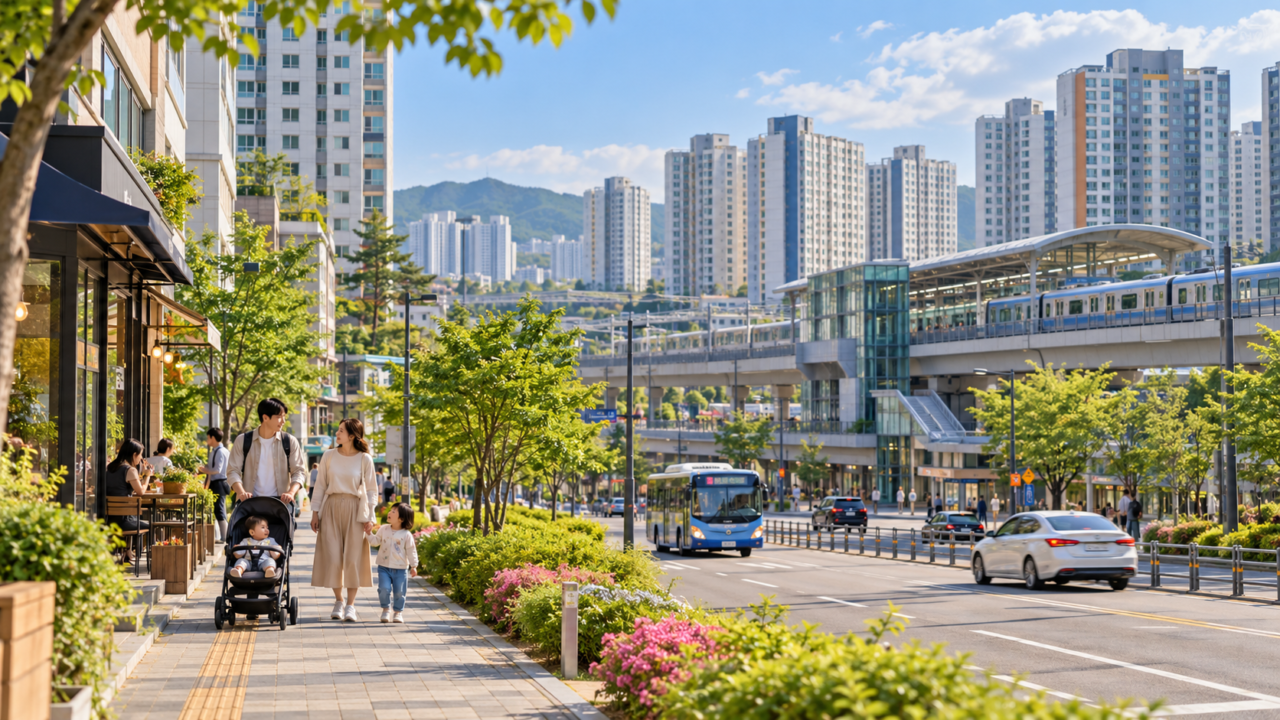
When people first start researching life in South Korea, there is a tendency to treat Seoul and Korea as if they are the same place.
They really aren’t.
I’ve lived in Korea for around 16 years, and during that time I’ve lived in places including Cheonan, Suwon, Gwangmyeong, Gimpo and Pyeongtaek.
And one thing I’ve learned is that where you live in Korea can completely change your experience of the country.
Seoul gives you incredible public transportation, restaurants, nightlife, jobs and basically anything else you can think of within reasonable reach.
But you pay for that convenience.
Outside Seoul, you can often get more space, quieter neighborhoods and easier access to parking and family-friendly areas. On the other hand, transportation becomes more important, English-speaking services may be harder to find, and depending on where you live, owning a car can go from being a luxury to feeling almost essential.
So the question shouldn’t really be:
“Should I live in Seoul or outside Seoul?”
A much better question is:
“What does my normal Tuesday look like?”
Because that will tell you where you should live much faster than any “Top 10 Korean Cities” article ever will.
First: “outside Seoul” can mean very different things
This is probably the most important distinction.
Living in Gwangmyeong is technically living outside Seoul.
Living in Pyeongtaek is also living outside Seoul.
Living in Cheonan is outside Seoul too.
Those three experiences are very different.
There is also the 수도권 (sudogwon), or Seoul Capital Area, which broadly includes Seoul, Incheon and Gyeonggi Province.
Some Gyeonggi cities are so closely connected to Seoul that daily life can still feel heavily Seoul-oriented. Move farther south or into smaller cities, and your lifestyle can change considerably.
This is why I wouldn’t choose a home simply because Google Maps tells me it is “only 30 km from Seoul.”
Thirty kilometres in Korea can mean almost anything depending on which subway line, bus route, highway and transfer you have to use.
A short distance with two terrible transfers can make you question every decision that led you there. 😅
Cheonan: where my Korean life started
Cheonan was my introduction to life outside Seoul.
I first came to Korea as a university student in 2010, so my experience of the city was obviously very different from my life today as a husband and father.
What I liked about Cheonan was that it still had basically everything I needed without feeling overwhelming.
Shopping, restaurants, universities, hospitals, nightlife and transportation were all available, but everyday life generally felt slower than Seoul.
Housing was also significantly more manageable for me when I later started working and living independently there.
When I rented my first officetel in Cheonan in 2016, I paid a ₩3 million deposit and ₩350,000 per month in rent.
Please do not read that sentence and immediately start searching for a ₩350,000 apartment in 2026. 😂
Housing prices have changed considerably since then, which is why I cover current budgeting separately in my Cost of Living in Korea guide.
But Cheonan taught me something that has stayed true throughout my time here:
You do not necessarily need Seoul to have a convenient Korean lifestyle.
Suwon: city life without actually living in Seoul
Suwon is a good example of why the phrase “outside Seoul” can be misleading.
You are outside Seoul, but you are still living in a major Korean city with substantial transportation, shopping, restaurants, hospitals and entertainment around you.
Places like this can give you a nice middle ground.
You still have access to the 수도권 (sudogwon) transport network, while potentially getting more housing for your money than you would in central Seoul.
But even here, I would pay far more attention to the specific neighborhood than simply seeing “Suwon” in the address.
Living close to a useful station can dramatically change your life.
Koreans often use the term 역세권 (yeokse-gwon), meaning an area conveniently located near a railway or subway station.
That word becomes very important when apartment hunting.
Being able to walk to a useful station is very different from living in the same city but needing a 20-minute bus journey before your train commute even begins.
Gwangmyeong: outside Seoul without really feeling far away
Gwangmyeong was another interesting experience for me because of how close it is to Seoul.
I moved there in 2018.
This is where you start realizing that administrative borders don’t necessarily match your real lifestyle.
You can technically leave Seoul while still being closely connected to it for work, shopping or social life.
For someone who needs frequent access to Seoul but doesn’t necessarily want to live in the city itself, locations around the Seoul boundary can make a lot of sense.
There is a catch, though.
Do not automatically assume that crossing the Seoul border means everything suddenly becomes cheap.
It doesn’t.
Some well-connected areas in Gyeonggi can still be expensive, especially when they offer strong transportation links or newer apartment developments.
“Outside Seoul” is not a discount code. 😄
Gimpo: when housing space started mattering more
Our priorities changed significantly once my wife and I started thinking more about family life.
We moved to Gimpo in 2022 and rented a larger home.
At that point, things like having more living space, parking, supermarkets, parks and a comfortable residential environment started becoming much more important than being close to nightlife.
Funny how quickly priorities change.
Twenty-something me wanted to know:
“How quickly can I get to Hongdae?”
Father me wants to know:
“Where is the nearest supermarket, hospital and playground?”
Life comes at you fast. 😂
Gimpo also taught me to look very carefully at the complete commute rather than just the railway map.
A city might have a rail connection into Seoul, but your home could still be several kilometres from that station.
That means walking, buses, transfers and waiting times need to be included in your calculation.
The train journey might look great.
Your front door to office journey may tell a very different story.
Pyeongtaek: where family life changed the calculation again
We eventually moved to Pyeongtaek in 2024.
Our current apartment is around 33평 (pyeong), or roughly 109 m², with three bedrooms and two bathrooms.
That amount of space works much better for us now that we’re a family of three.
Pyeongtaek is also a good example of a city where your experience depends heavily on where you live and work.
Some areas are well connected by rail, while others are much more comfortable if you own a car. Pyeongtaek-Jije, for example, connects SRT high-speed rail with Seoul Metropolitan Subway Line 1, so being farther from central Seoul does not automatically mean being disconnected from the wider transport network. SR
But this is where I would strongly recommend opening Naver Map or KakaoMap before signing any housing contract.
Don’t just search:
Pyeongtaek → Seoul
Search:
Apartment → workplace at 7:30 a.m.
Then check the return trip at 6 p.m.
That is the commute you are actually buying.
Housing is one of the biggest advantages — but don’t oversimplify it
One of the obvious attractions of living farther from central Seoul is housing.
Your budget may get you a larger apartment, newer building or better parking.
But there is a dangerous assumption that I often see:
Seoul = expensive. Outside Seoul = cheap.
Reality is much messier.
Some highly desirable parts of Gyeonggi can cost considerably more than smaller cities farther south. Even within the same city, prices can change dramatically depending on the station, school district, apartment age and local development.
So don’t compare city names.
Compare actual apartments.
Look at the deposit, 월세 (wolse, monthly rent), 관리비 (gwanribi, management fee), utilities and transportation costs together.
I explain the Korean rental system in more detail in my Wolse vs Jeonse guide and Korean apartment management-fee guide.
That total monthly cost is what matters.
A car becomes more useful the farther you move from good public transport
Do you need a car in Korea?
In Seoul?
Usually, no.
In a well-connected part of Suwon, Gwangmyeong or another major city?
You can probably live quite comfortably without one.
But the farther you move from major public transportation, the more useful a car becomes.
For our family, having a car is now extremely convenient.
Grocery shopping, travelling with our son, weekend trips and getting between areas without convenient rail connections are considerably easier.
But I wouldn’t buy one simply because I’m living outside Seoul.
If your apartment, workplace, supermarket and daily activities are all conveniently connected by public transport, the cost of buying, insuring, parking and running a vehicle may not make sense.
You can compare the alternative in my Public Transportation in South Korea guide.
Your Korean ability matters more outside major international areas
You can absolutely live outside Seoul without speaking fluent Korean.
But Korean becomes increasingly useful.
At major banks, hospitals and international neighborhoods in Seoul, finding some English assistance may be relatively easy.
At the small clinic five minutes from your apartment in a quieter neighborhood?
Maybe.
Maybe not. 😅
This applies to real-estate agents, apartment management offices, local repair technicians, restaurants and government services too.
You don’t need to become fluent before moving outside Seoul, but learning practical Korean makes life considerably easier.
Even simple phrases can remove a lot of stress.
I put together a Practical Korean Phrases guide specifically for situations like these.
Social life can require more effort
Seoul is very easy socially because there are simply so many people.
International groups, language exchanges, nightlife, clubs, events and foreign communities are everywhere.
Outside Seoul, you may need to make more deliberate efforts.
That doesn’t mean there aren’t foreigners around.
There are international communities across Korea, especially around universities, industrial areas, international companies and military communities.
But you may not have ten different events happening within three subway stops every Friday night.
Personally, I don’t see that as a negative anymore.
My lifestyle today is very different from when I was younger.
Back then, being able to reach Hongdae or Itaewon easily mattered much more.
Today?
Give me a quiet apartment, decent parking, somewhere my son can run around and a good café nearby.
Character development. 😂
Families should look beyond transportation
If you’re moving with children, I would look at the neighborhood very differently from someone moving alone.
The important things become schools, daycare, playgrounds, hospitals, supermarkets, parks, parking and how long everyday errands take.
A beautiful apartment that requires a 25-minute drive every time you need something simple can get annoying very quickly.
This is why I recommend exploring potential neighborhoods in person before signing a lease whenever possible.
Walk around.
Visit the supermarket.
Look for clinics.
Check where children are playing.
See what the neighborhood feels like around 7 p.m., not just at 2 p.m. during the apartment viewing.
You’re not only renting an apartment.
You’re renting the surrounding lifestyle.
So, should foreigners live outside Seoul?
For many people, absolutely.
But I wouldn’t move outside Seoul simply because someone told me the rent is cheaper.
I would choose based on work location, transportation, housing, family situation and what I actually do every week.
If your job and social life are both in central Seoul five or six days a week, saving a little money on rent while spending three hours commuting every day probably isn’t the victory it first appears to be.
Your cheaper apartment might slowly collect payment in another currency:
your sanity.
On the other hand, if you work outside Seoul, work remotely, have a family, prefer quieter neighborhoods or simply don’t need central Seoul every day, living elsewhere can make a lot of sense.
After living in several Korean cities, I no longer think of Seoul as the automatic “best” place to live.
It is one option.
A very good option for some people.
But Korea is much bigger than Seoul.
And sometimes the best place to live is simply the place where your ordinary Tuesday is easiest.